Why Data Freshness Decides Whether a Higher or Lower Game Is Fair
The one fact separating a fair comparison game from a guessing game is the age of its data — and most of the genre never publishes it. Here is how we measure it.
Published August 23, 2026 · Updated August 23, 2026
Independent directory. Not affiliated with the games listed.
Every game in this genre is a dataset with a button on it. You are shown two things and asked which number is bigger — so the only thing that makes your answer right or wrong is the numbers the game is holding.
Which raises a question almost nobody in the genre answers: when were those numbers captured?
Why it matters more here than it looks
Your intuition about relative size is calibrated to the present. You know roughly how many subscribers a big YouTube channel has today, roughly what a well-known company is worth this year, roughly how a film is rated now.
A game running on a five-year-old snapshot is not testing that intuition. It is testing your memory of a moment you were not asked to remember. You lose rounds you should win, the game feels arbitrary, and there is nothing on screen to tell you why.
Some data ages faster than other data:
| Data type | How fast it moves | Undated snapshot is… |
|---|---|---|
| Market capitalisation | Every trading day | Wrong within weeks |
| Subscriber and follower counts | Continuously, one direction | Progressively easier |
| Search volume | Continuously, both directions | Quietly misleading |
| Property prices | Monthly, regionally | Regionally wrong |
| Film ratings | Slowly, then suddenly | Fine for months |
| Box office totals | Fast, then settles | Fine once settled |
| Country populations | Yearly | Fine for a year or two |
| Pokémon base stats | Never | Always fine |
The bottom of that table is why Pokémon games age gracefully and market cap games do not.
What we found when we looked
We opened every listed game and recorded what it publishes about its own data. Three patterns came out of it.
Some games get it exactly right. AnimeHOL prints its capture date on the screen you play from — 27 November 2025, stated next to the data source. Market Cap Game does the same thing in one sentence under its title: All stats are based on the market capitalization of the companies. Updated November 2025.
Neither game is claiming to be current. Both are telling you exactly what you are playing, which is all anyone can reasonably ask.
Some publish nothing at all. The Higher Lower Game — the game that started the genre, built entirely on Google search volume — has no data source, no capture date and no note anywhere on its home page. That is not a small omission for a game whose whole premise is a dataset.
Some name the data but not the date. The GeographyGames version tells you clearly that you are comparing population, GDP per capita or McDonald’s restaurant counts. It does not say where those figures came from or when. Two of those three move every year.
The labels we use
Every listing here carries one of these, derived mechanically from two recorded fields rather than assigned by opinion:
- Live Data — the game queries its source when you play. The strictest label we award.
- Updated This Month — a published refresh date inside the current month.
- Updated This Year — a published refresh date inside the current year.
- Updated in the previous year — exactly one calendar year behind. Usable, not recent.
- Outdated Data — more than a full calendar year behind.
- Update Date Unknown — the game does not say.
- No dataset — counting games and card games, where the question does not apply.
Two rules govern all of them. We never infer a date a developer has not published, and we never treat “unknown” as an accusation. It is an absence, and it is recorded as one.
What to do with this
If you are choosing a game to play: check the badge before you start. A game with an honest, recent date will feel fair. A game with an unknown date might be fine — you just cannot know.
If you build one of these games: publish your capture date on the page. It costs you one sentence, it is the single most useful thing you can tell a player, and it is the fastest way to look better than most of your competitors.
Platforms covered here

The original, and still the cleanest expression of the format — but it has never published a date for the search volumes it runs on, which is now the main thing standing between it and a recommendation.
higherlowergame.com
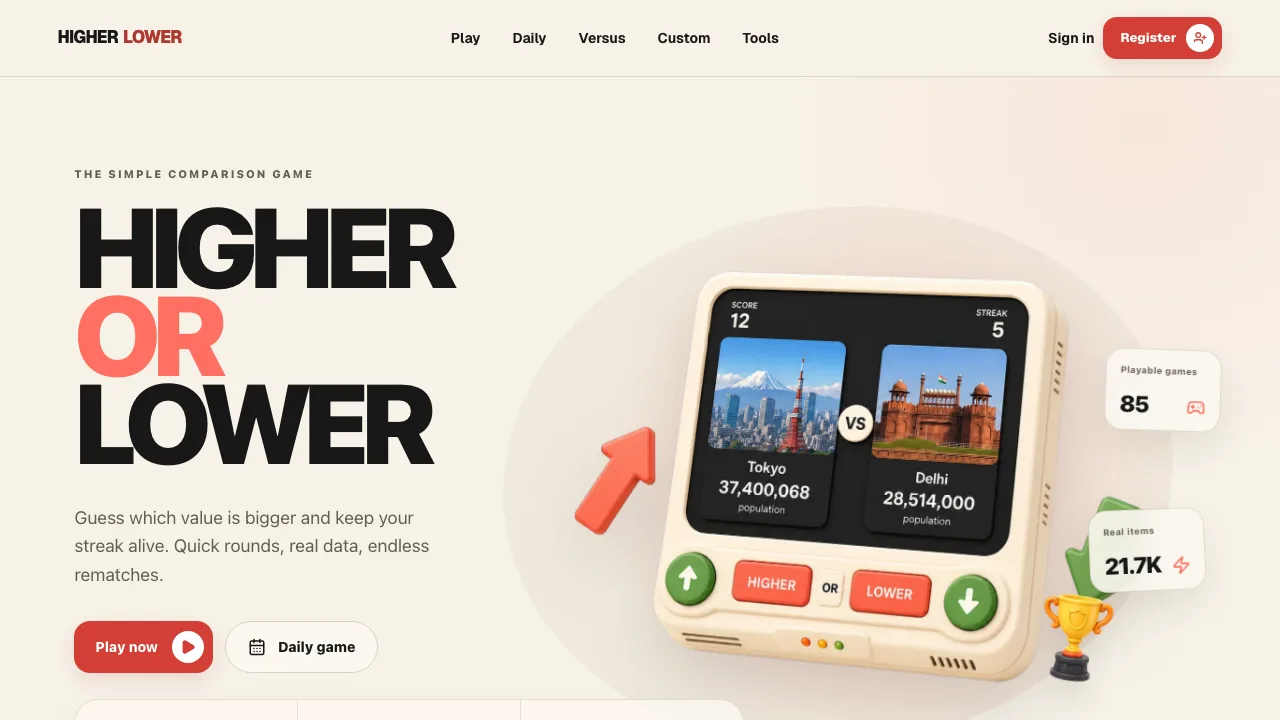
The most complete free platform in the genre: daily, versus and a custom builder in one place, with no ad networks loading at all — a combination nothing else we tested matches.
playhigherlower.com
Games covered here

The only game in this first batch that prints its data capture date on screen before you play, and it does it with no ads and four difficulty tiers. The mobile layout is the weak point.
animehol.com
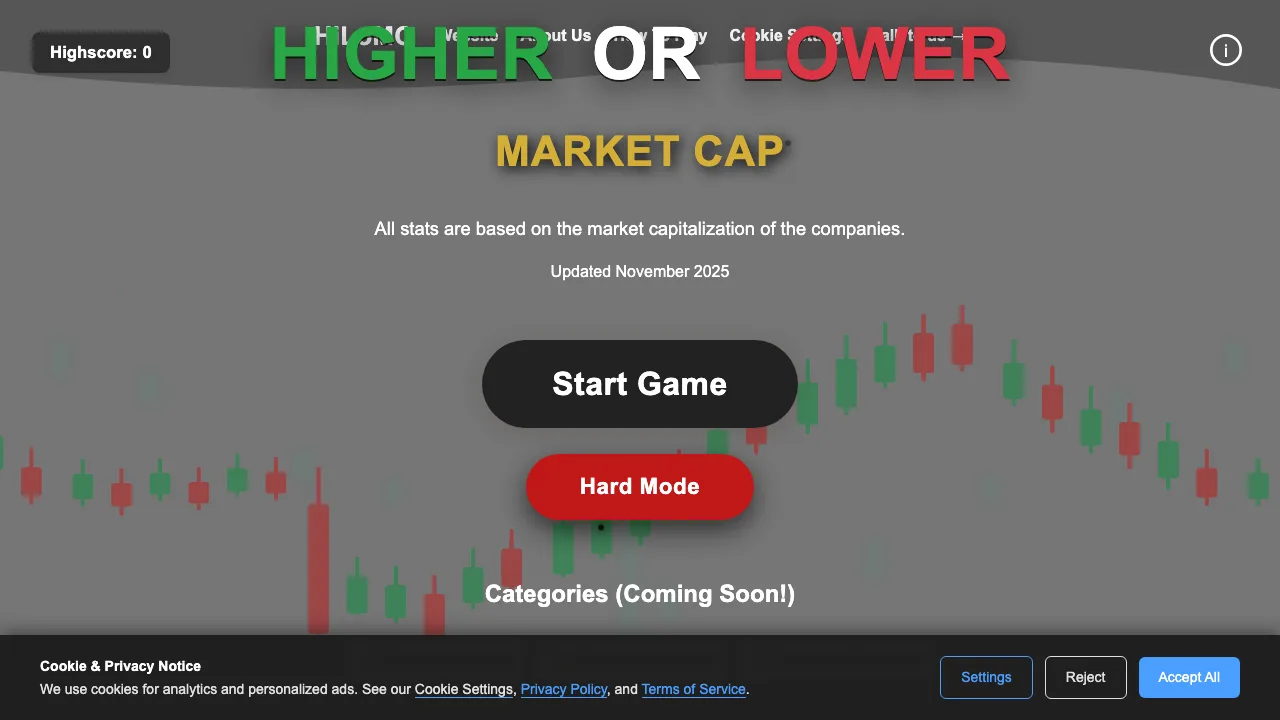
A single-topic game that does the important thing right: it prints its data month on the page, next to the start button, where you cannot miss it before playing.
HiLoMC

The rare geography game that ships all three formats — endless, head-to-head and a shared daily — and explains its rules before you start. The ad load is the price you pay.
GeographyGames